Best AI Detector (2026): 7 Picks, Limits Spelled Out
We may earn a commission when you buy through links on our site, at no extra cost to you. Learn more

Quick answer
GPTZero is the easiest place to start because the vendor lists a free plan with 10,000 words a month, and Originality.ai suits teams that scan many articles. Copyleaks is the alternative if you need many languages or an API. No detector is perfect, so use scores as a prompt to look closer, not as proof.
An AI detector estimates how likely a text is to be machine-written, and every vendor admits the answer is a probability. The useful question is which tool fits your workflow and how much its published numbers can be trusted.
We compared features, vendor documentation and user reviews for seven detectors sold in the US, UK, EU, Canada and Australia. Accuracy and false positive figures are attributed to whoever published them, and we flag when they come from the vendor alone.
Below you will find the seven picks, a comparison table we compiled ourselves, common complaints, scenarios, and an FAQ. We did not run hands-on tests.
Our Top Picks
Originality.ai7.5/10
Originality.ai pairs AI detection with plagiarism checks and sells WordPress, Chrome and Moodle integrations.
Read our full take ↓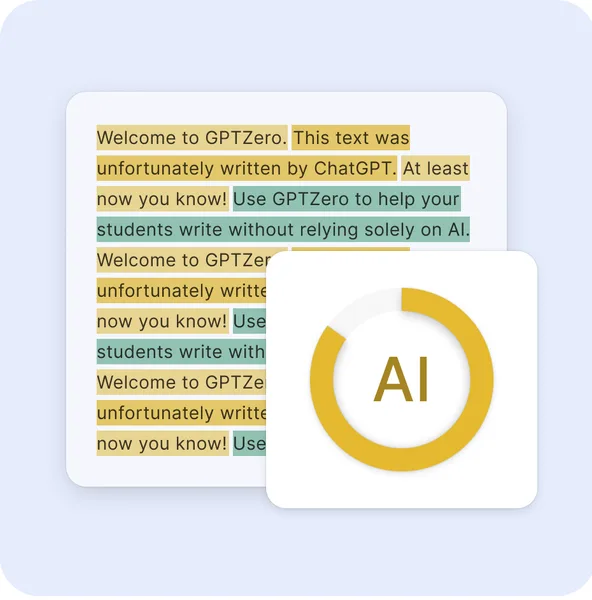
GPTZero8.5/10
GPTZero lists a free plan with 10,000 words scanned per month and paid tiers for heavier use.
Read our full take ↓
Copyleaks8.0/10
Copyleaks lists detection in 30 languages, a free web tool and an API for developers.
Read our full take ↓- Originality.aiBest for Publishers and Agencies7.5
- GPTZeroBest Free Starting Point8.5
- CopyleaksBest for Many Languages8.0
- Winston AIBest Credit-Based Allowance7.5
- PangramBest for Cited Independent Studies8.0
- QuillBot AI DetectorBest Free Check Without an Account7.8
- Grammarly AI Detector and AuthorshipBest for Documenting the Writing Process7.8
- TurnitinBest for Institutions7.0
| Product | Our score | Best for | Link |
|---|---|---|---|
| Best for Publishers and Agencies Originality.ai | 7.5 | Content teams that scan many articles from freelancers | Check Originality.ai |
| Best Free Starting Point GPTZero | 8.5 | Students, writers and teachers who want a free first check | Check GPTZero |
| Best for Many Languages Copyleaks | 8.0 | Multilingual teams and developers who need an API | Check Copyleaks |
| Best Credit-Based Allowance Winston AI | 7.5 | Editors who also want plagiarism and fact-checking in one account | Check Winston AI |
| Best for Cited Independent Studies Pangram | 8.0 | Editors and researchers who want evidence beyond vendor claims | Check Pangram |
| Best Free Check Without an Account QuillBot AI Detector | 7.8 | Writers who already use QuillBot's other tools | Check QuillBot |
| Best for Documenting the Writing Process Grammarly AI Detector and Authorship | 7.8 | Students and professionals who need to show how their work was written | Check Grammarly |
| Best for Institutions Turnitin | 7.0 | Schools and universities that already license Turnitin | Check Turnitin |
1. Originality.ai — Best for Publishers and Agencies
What we like
- The vendor lists a WordPress plugin that can scan one post or a whole site
- A Chrome extension works inside Google Docs and can replay how a document was written
- A Moodle plugin exists for course assignments
- Offers a choice of detection models, including a multi-language option the vendor puts at 30 languages
Keep in mind
- Credit-based billing takes some planning
- Pricing pages we found disagree with each other, so the live price must be checked
- Accuracy figures are the vendor's own
Originality.ai is built around publishing workflows. The vendor's WordPress plugin page says it can scan a single post or an entire site, and a Chrome extension runs inside Google Docs and can scan a web page or selected text. The extension also offers a replay of how a document was written, which gives an editor context beyond a single score.
The company states a 99%+ accuracy figure and a false positive rate under 1% on its own pages, and also says its scores reflect probability, not guilt. We treat both as vendor claims, because we found no independent audit of those numbers in this research. Credits are word-based, with the plugin page saying 1 credit equals 100 words (a help article says scans that check both AI and plagiarism use more), and a limited free scan tool exists for a quick look.
Pricing pages for this product show different plan figures, some of them from older pages, so we are not printing a number. Check the current price on the vendor page.
Skip it if you only need an occasional free check of a short text, since the paid setup is aimed at teams that scan regularly.
2. GPTZero — Best Free Starting Point
What we like
- GPTZero describes a free plan with no credit card that scans up to 10,000 words a month
- The free plan includes advanced detection, multilingual detection and writing feedback, per the vendor
- Paid tiers add higher monthly word limits
- GPTZero is included in third-party comparisons that Pangram summarizes on its site
Keep in mind
- Paid plan prices differ between GPTZero pages and articles
- Free scans have a per-document size limit according to one source
- Independent comparisons of detectors differ in their results, so test your own text
GPTZero is the easiest place to begin because the vendor describes a free plan that needs no credit card and covers up to 10,000 words per month. That is enough to check an essay or a handful of articles, and the plan includes multilingual detection and writing feedback according to GPTZero's own pages.
For independent context, Pangram's write-up of third-party evaluations includes GPTZero in its comparisons. That source is a competitor's summary, so treat it as a pointer to the original studies rather than a verdict. GPTZero's own pages describe paid tiers with higher monthly word limits, but the figures varied between pages we found.
Because the free tier is real, GPTZero is a sensible baseline to compare any other detector against.
Skip it if you need to scan hundreds of thousands of words every month without checking plan limits first.
3. Copyleaks — Best for Many Languages
What we like
- API docs list 30 supported languages with ISO codes
- Copyleaks' marketing page says the free web tool takes up to 25,000 characters per scan without logging in
- The API classifies text section by section and has adjustable detection levels
- Also sells AI image detection through its API
Keep in mind
- Only six languages get the AI Logic explanation, per the docs
- The 99%+ accuracy figure comes from internal testing on English datasets, as the vendor notes
- Pricing figures conflict across the pages we found
Copyleaks documents its language coverage more openly than most competitors. The API reference lists 30 languages for AI detection, including Spanish, Japanese, Arabic and Hindi, and says the AI Logic explanation feature covers six of them: English, Spanish, French, Portuguese, German and Italian. That level of detail helps a team decide whether a non-English workflow is realistic.
The vendor's marketing page says the free web tool accepts up to 25,000 characters per scan without an account and flags mixed human and AI text, though its FAQ ties that limit to the browser extension, so confirm the limit. Paid plans are credit-based, with one credit covering up to 250 words or one image, and the vendor sends education and enterprise buyers to sales for custom pricing. The company reports 99%+ accuracy, and a vendor page notes that the number comes from internal testing on English datasets.
Our reading is that Copyleaks fits teams that mix languages or want to wire detection into their own software.
Skip it if you work only in English and want one plain price with no credit math.
4. Winston AI — Best Credit-Based Allowance
What we like
- The help center lists AI detection at 1 credit per word and plagiarism at 2 credits per word
- A free plan with 2,000 credits and a 14-day trial is listed
- Three paid tiers carry 100,000, 200,000 and 500,000 monthly credits
- Image detection is available through the API
Keep in mind
- Plagiarism checking is not on the Essential plan, per the help center
- Only Elite users can top up credits mid-cycle
- Third-party articles quote prices that disagree with the vendor's page
Winston AI's pricing is a credit system, and the vendor's help center spells out the burn rate: the AI detector costs 1 credit per word, plagiarism checking costs 2 credits per word, and writing feedback, the fact checker and the essay grader are each 1 credit per word. At those rates, the free plan's 2,000 credits cover roughly 2,000 words of detection, which is enough for a trial but not a routine.
The paid tiers list 100,000, 200,000 and 500,000 credits per month, and the help center says not all features are on every plan. Plagiarism checking, for example, is not on the Essential AI plan. Only Elite users can purchase additional credits mid-cycle, so lower tiers wait for the next billing period.
Winston also publishes comparison pages against GPTZero and Originality.ai, which are marketing material, not independent tests.
Skip it if you check long documents often and want to avoid doing credit arithmetic.
5. Pangram — Best for Cited Independent Studies
What we like
- Pangram's page on third-party evaluations lists academic studies that compared it with other detectors
- Pangram says one study found 97.5% detection of fully AI-written and 95% of humanized papers
- The vendor offers multilingual detection and an image detector in research preview
- A free tier is offered
Keep in mind
- Free scan limits differ across Pangram pages
- Most of the favorable numbers are published by Pangram itself
- Short texts and newer AI models remain harder for every detector
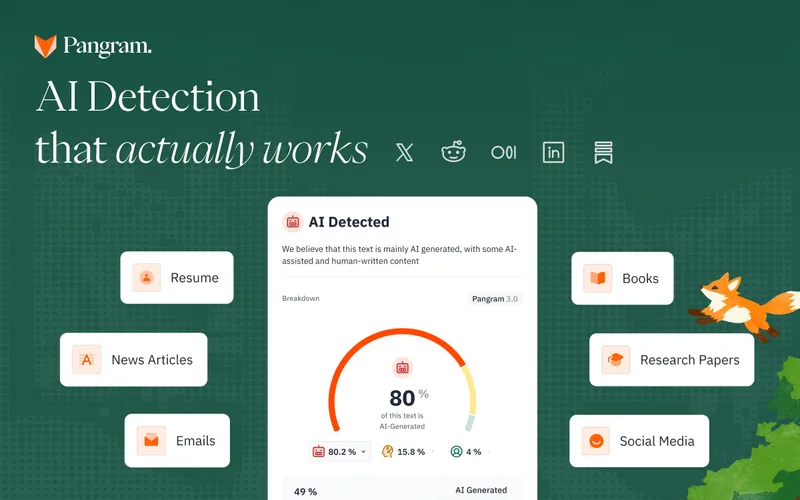
Pangram's selling point is evidence. Its own site advertises 99.98% accuracy and a false positive rate of about 1 in 10,000, which are vendor claims. More useful are the third-party studies it lists: academic comparisons of several detectors, including one where Pangram reports 97.5% detection of fully AI-written and 95% of humanized papers.
Pangram's pages summarize those studies, so a careful buyer should open the original papers before relying on the percentages. Vendor marketing figures and independent figures rarely match, which is worth keeping in mind for any tool in this list.
Plan information is inconsistent across the pages we found: one lists an individual plan at 300,000 words per month, another a plan by scan count, and free scan allowances range from 3 to 20 per day depending on the page. Check the live pricing page before you decide.
Skip it if you need a single, clearly published free allowance.
6. QuillBot AI Detector — Best Free Check Without an Account
What we like
- Free scans of up to 1,200 words without signing up, per the vendor
- Premium removes the word cap
- Sits in a suite with a grammar checker, paraphraser and plagiarism checker
- The page recommends at least 80 words for better accuracy
Keep in mind
- The free tier has a daily scan limit, which one page puts at six
- Language coverage is stated differently on different pages (6 or 20+)
- We found no independent accuracy study
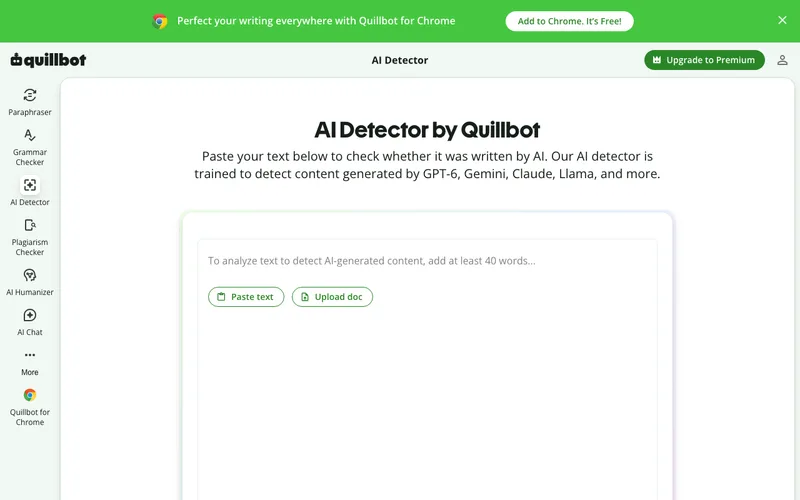
QuillBot's detector is a convenient extra for people who already use the company's writing tools. The free version takes up to 1,200 words per scan without registration, and the vendor says Premium removes that cap. Its page advises at least 80 words of text for better accuracy, which is a reminder that very short samples are unreliable in every tool.
Language support is described inconsistently: a recent page says 20+ languages, while an older blog post lists six, so confirm your language before relying on it. We found no independent study measuring this detector, so its accuracy is unproven in this research.
For detection alone, the free scan works as a quick second opinion beside GPTZero.
Skip it if you need audited accuracy numbers or long-document scanning without a subscription.
7. Grammarly AI Detector and Authorship — Best for Documenting the Writing Process
What we like
- Grammarly says basic Authorship tracking is available to all users in Google Docs and Microsoft Word, with unlimited reports
- Authorship records pasted text sources, per the vendor, instead of analyzing finished text
- paid plans add AI and plagiarism detection to Authorship reports
- Grammarly states no AI detector is 100% accurate
Keep in mind
- Detailed attribution of copied AI text needs a paid plan
- Authorship only covers text written inside supported editors
- We found no independent accuracy study of the detector
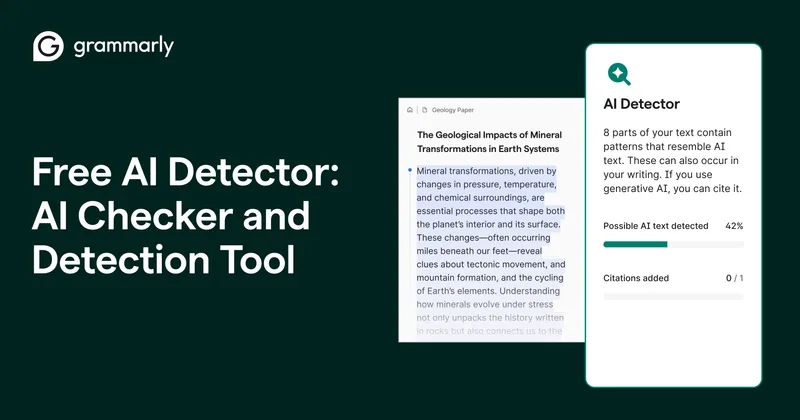
Grammarly takes two routes. Its free AI detector reads finished text, splits it into sections and gives an overall percentage. Its Authorship feature, in contrast, tracks the writing as it happens in Google Docs and Microsoft Word, and uses clipboard information to label pasted text as coming from a generative AI tool, a website or an unknown source, according to Grammarly's help center.
That second route suits people who expect to be asked to prove their process rather than argue with a percentage. Grammarly itself says no AI detector is 100% accurate and recommends pairing detection with Authorship and plagiarism checks. Basic Authorship tracking is available to all users, while detailed attribution and in-report AI detection are on paid plans.
Because Authorship works only in the editors it supports, text drafted elsewhere has no record to show.
Skip it if you write in apps that Grammarly does not cover.
8. Turnitin — Best for Institutions
What we like
- Turnitin scores each sentence from 0 to 1 and averages them into a document estimate
- It publishes a document-level false positive rate under 1% for papers with 20% or more flagged text
- It says it does not make a finding of misconduct from the detector alone
- Reports show an asterisk, not a score, for results in the below-20% range
Keep in mind
- Sold to institutions, so individuals usually cannot buy it
- Sentence-level false positives are around 4%, per Turnitin
- Independent researchers have challenged Turnitin's bias claims for English language learners
Turnitin is the detector many students meet through their school, not one a freelancer subscribes to. Its published method splits a paper into overlapping segments of a few hundred words, scores each sentence between 0 and 1 for likelihood of AI origin, and averages those scores into a document-level estimate.
The company is more open about error rates than most. It reports a document false positive rate under 1% for papers with 20% or more flagged text, and a sentence-level false positive rate of around 4%. It adds that results below 20% are less reliable, so the report shows an asterisk instead of a score. Turnitin states that it does not make a misconduct finding from the detector, and says its testing found no statistically significant bias against English language learners, which independent researchers have disputed.
These are the vendor's numbers, and we found no independent audit of them in this research.
Skip it if you are an individual buyer, since access normally comes through an institution.
How we compared the detectors
We read each vendor’s own product pages, help centers and documentation, then looked for independent studies. Where a number came only from the vendor we say so. We left out any price that conflicted between pages and point you to the live pricing page instead. If you are choosing the best ai detector for a team, begin with the free tiers, run the same sample text through two or three tools, and see where they disagree.
Comparison table
Compiled from the vendor pages in our sources. A dash means we found no published figure.
| Tool | Free option | Languages | Integrations | Independent study cited |
|---|---|---|---|---|
| Originality.ai | Limited free scan tool | 30 (multi-language model) | WordPress, Chrome, Moodle | — |
| GPTZero | 10,000 words/month | Multilingual | — | Cited by Pangram |
| Copyleaks | Web tool, 25,000 characters | 30 | API | — |
| Winston AI | 2,000 credits, 14-day trial | — | API | — |
| Pangram | Yes, limit varies by page | Multilingual page | — | Several, via Pangram |
| QuillBot | 1,200 words/scan | 6 or 20+ | QuillBot suite | — |
| Grammarly | Free detector and basic Authorship | — | Google Docs, Word | — |
| Turnitin | — | Includes Arabic | Institution LMS | — |
Common complaints about AI detectors
Across vendor FAQs and the studies we found, the same problems recur. False positives are the main one, and Turnitin itself says its sentence-level false positive rate is around 4%. Short samples are unreliable, which is why QuillBot recommends at least 80 words. Results differ between tools on the same text, and humanized or edited AI text is harder to catch. Bias concerns for non-native writers have also been raised by independent researchers about Turnitin.
Scenarios
An editor with freelancers submitting 20 articles a week fits Originality.ai or Winston AI, since both sell team-style plans and Originality.ai has a WordPress plugin. A solo blogger checking one draft can use the free tier of GPTZero. A student who wants to show their process should look at Grammarly Authorship while drafting. A developer building detection into an app should start with Copyleaks or Winston AI’s API documentation.
Using detectors responsibly
Treat a score as a reason to look closer, not as evidence of misconduct. Turnitin says it does not make a misconduct finding from the detector alone, and Grammarly says no detector is 100% accurate. Use scores for editing, originality checks and policy compliance, and keep a draft history. If you publish AI-assisted content such as voiceovers or avatar video, read the usage rules of the tools involved, for example in our ElevenLabs pricing guide. If you also paraphrase or edit with AI, our QuillBot review covers its plagiarism checker and plan limits.
Who should skip paid detectors
If you only check an occasional text, the free tiers above are enough. If your writing already includes a document history in Google Docs or Word, Authorship-style records may answer questions better than a percentage. Teams with legal or academic stakes should write down their review process before they buy any tool.
Frequently Asked Questions
Which AI detector is the most accurate?
No independent source we found settles this. Vendors publish figures of 99% or more, while third-party studies cited on Pangram's site report lower numbers, and Pangram lists several academic studies. Test two tools on your own text.
Is there a free AI detector?
GPTZero lists 10,000 free words per month, QuillBot lists free scans up to 1,200 words, Copyleaks has a free web tool, and Grammarly offers a free detector. Limits change, so read each vendor page.
Can an AI detector give false positives?
Yes. Turnitin publishes a sentence-level false positive rate of around 4% and a document-level rate under 1% for papers with 20% or more flagged text. Other vendors publish their own numbers.
Can individuals buy Turnitin?
Turnitin is sold to institutions, so most people reach it through a school or university.
What is the difference between detection and Authorship?
A detector analyzes finished text. Grammarly's Authorship records how text was created inside Google Docs or Word, so it produces a history rather than a probability.
Do detectors work in other languages?
Copyleaks lists 30 languages in its API docs and Originality.ai lists a 30-language model, but support varies by feature, so check the vendor's language list.
Final Verdict
GPTZero is a sensible free starting point, Originality.ai fits publishing teams, Copyleaks fits multilingual and developer needs, and Pangram points to the most third-party studies. Grammarly Authorship suits people who need to document how they wrote something. Treat every score as a probability and check live pricing before you pay.
Sources We Checked
Specs and features in this guide come from these manufacturer pages and independent sources, checked on Oct 14, 2026.
- Originality.ai WordPress plugin
- Originality.ai Chrome extension help
- Copyleaks AI detection supported languages
- Copyleaks pricing
- Winston AI pricing
- Winston AI help center: text analysis
- Turnitin: understanding false positive rates
- Grammarly about Authorship
- GPTZero homepage and free plan
- QuillBot AI detector
- Pangram third-party evaluations